Van Dyke Beard Guide: Separate Gaps and a Pointed Chin
A Van Dyke combines a separate mustache with a narrow, pointed chin beard while clean skin remains visible at both mouth corners. The style depends on preserving those gaps before refining the point, reducing bulk gradually, and checking the shape from an ordinary viewing distance.
Try On This Style
- Length
- A separate mustache sits above a narrow chin section that finishes in a visible point.
- Maintenance
- Requires protecting both mouth-corner gaps, reducing bulk gradually, and checking that the point remains centered.
- Could it suit you?
- Worth considering when mustache and chin growth can remain visually separate, a pointed outline is preferred, and precise gap cleanup is acceptable.
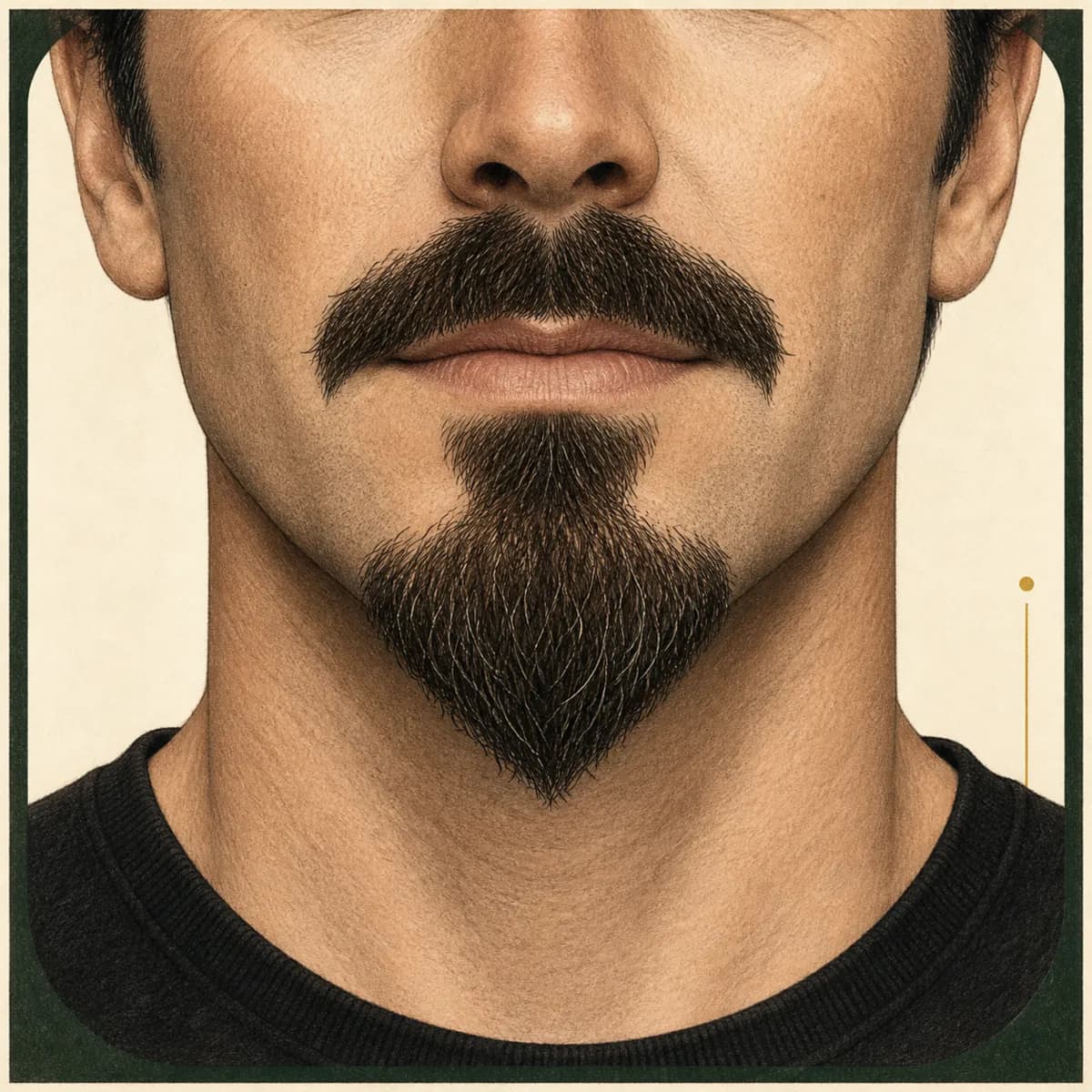
What a Van Dyke Is
A Van Dyke pairs a distinct mustache with a chin beard that narrows into a visible point. Clean skin at both mouth corners separates the upper and lower parts. The cheeks and jaw sides stay clear, so the design is read through three elements: the mustache, the two gaps, and the pointed chin section.
The gaps are structural, not unfinished connectors waiting to grow in. If hair closes both corners and surrounds the mouth, the outline becomes a Circle Beard. If the lower beard expands broadly across the front jaw, it moves toward a Balbo rather than retaining the Van Dyke's narrow point.
Could It Suit You?
Look separately at upper-lip growth, the area below the lower lip, and the center of the chin. The style is easier to define when the mustache and chin sections each have enough visible continuity while both mouth corners can be cleared without cutting deeply into them. A natural narrowing toward the lower chin can help the point read clearly, but perfect symmetry is not a prerequisite.
Choose it for the separated, pointed outline rather than for a promised face-shape effect. Consider whether you like visible clean space beside the mouth and whether you are willing to protect it whenever you trim. Growth distribution, the preferred sharpness of the point, and tolerance for detailed edge work are more useful than a claim that one face shape guarantees a result.
How to Trim and Maintain It
Preserve the two mouth-corner gaps before shaping the point. Mark them with enough space to read from a normal viewing distance, then check that neither side climbs higher or cuts farther inward than the other. Keep extra material on the chin while establishing these gaps so the lower section does not become narrow by accident.
Reduce bulk in gradual passes. Work from the wider upper chin toward the intended tip, alternating sides and stepping back often. The point should be judged at conversational distance, where a slight off-center edge is easier to see than it is in a close mirror. Clean the cheeks and jaw sides only after the mustache, gaps, and chin point agree as one composition.
During later cleanup, protect the open corners first. Stray hairs growing through either gap can make the style look partially connected, while aggressive trimming at the tip can shorten or blunt the point. Make small corrections and recheck the center line before taking more length away.
Common Van Dyke Mistakes
Letting one or both mouth-corner gaps close is the clearest structural mistake because it removes the separation that defines the style. Unequal gaps can also pull the mustache and chin section visually to one side, even when the point itself is centered.
Trying to carve the final point in one pass often removes too much bulk or creates a thin, off-center tip. Inspecting only from very close range can hide that imbalance. Another common drift is widening the lower section along the front jaw until it reads as a Balbo; keep the Van Dyke narrow enough that the point remains the dominant lower shape.
Van Dyke Compared with Goatee, Circle Beard, and Balbo
A goatee is more broadly defined by hair centered below the lower lip and on the chin. It may omit the mustache or keep one separate, and it does not require the same pointed finish. The Van Dyke makes the separate mustache, bilateral skin gaps, and pointed chin a coordinated set.
A Circle Beard does the opposite at the mouth corners: it connects the mustache to the chin on both sides and closes the outline around the mouth. A Balbo keeps its mustache separate, like a Van Dyke, but its lower section covers a broader area across the chin and front jaw. The Van Dyke remains the narrower and more pointed of the two.
The Anchor beard adds two short arms along the front jaw to a pointed chin. Compare that outline if you want more width beside the chin while keeping the mustache separate.
Related beard styles




Related guides
Try On This Style
AI previews are illustrations, not guaranteed results. Your facial hair growth, face, lighting, and photo can change the preview and the result you can achieve with trimming.
Try On This Style