Imperial Beard Guide: A Swept Mustache with a Compact Chin Point
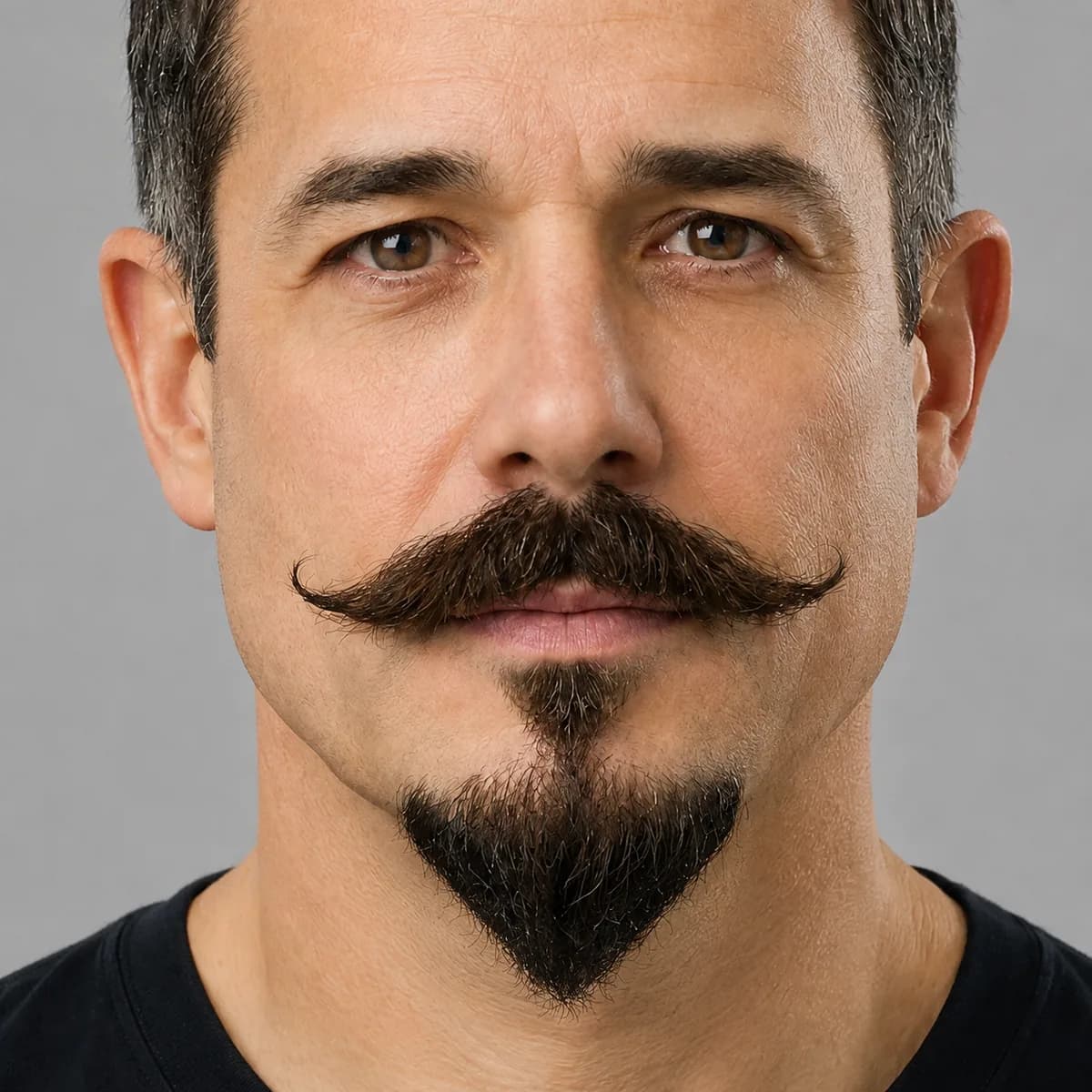
This Imperial beard uses a prominent mustache swept outward from the center, paired with a defined soul patch and compact pointed chin beard. The upper and lower shapes remain visually distinct, while clean cheeks and jaw sides give the mustache room to dominate.
Maintained by BeardStylesContent updated:
Latest recorded revision: Added the style definition, growth requirements, maintenance guidance, common mistakes and related-style comparisons.
Content and source methodSave this style in this browser to compare it later. Saved styles do not sync across devices, and clearing browser data removes them.

- Length
- Preserve enough mustache length for an outward sweep while keeping the chin point compact and separately balanced.
- Maintenance
- Set the mustache with fingers or a comb before trimming; edge the chin only after checking the upper silhouette.
- Could it suit you?
- Most practical when upper-lip growth can support extended swept tips and centered chin growth can form a compact point without cheek coverage.
What the Local Imperial Beard Means
The Imperial beard on BeardStyles pairs a large, outward-swept mustache with a small pointed chin beard and a defined patch below the lower lip. A visible distinction remains between the mustache and lower section. Cheeks and jaw sides stay clean. The mustache is the leading shape; the chin anchors it without becoming a broad goatee.
“Imperial” may describe a mustache alone in other catalogs. Gillette's handlebar guide uses “Imperial handlebar” for a thick mustache with tips twisted upward. This page covers the local paired beard geometry, so show the contour as well as the name when requesting the style.
Is the Geometry Available?
Allow the mustache to fall naturally, then test whether both halves can be directed outward without exposing a large thin area at the center. The two tips do not need equal hair counts, but they should reach comparable visual endpoints. Below, check that the soul patch and chin can hold a centered point.
This style exchanges cheek coverage for upper-lip coverage and daily shaping effort. It can change the perceived balance of the face, but it cannot guarantee a face-shape correction. If the mustache will not hold an extended silhouette or you prefer less styling, the Royale is the more restrained comparison.
How to Trim and Set the Shape
- Comb the dry mustache from the center outward before deciding what to cut. Start by removing only hairs that cannot be directed into the intended sweep; use the length chart for the compact lower section.
- Establish clean cheek and jaw fields, leaving extra space around the mustache endpoints. Open the mouth-corner separation carefully so both sides stop at matching positions.
- Define the lower-lip patch and carry it toward a compact chin beard. Shape one centered point without extending hair along the front jaw.
- Set the mustache in its intended outward direction with a comb, fingers and, if desired, a small amount of styling product. Trim only after seeing the styled silhouette, because unstaged ends appear longer and lower.
- Compare tip height, tip reach and chin center separately. Correct the largest visible mismatch first; alternating tiny cuts across all three can shrink the design without improving it.
The mustache may need restyling more often than the chin needs reshaping. Wash out styling product before a structural trim, and avoid using a fixed timetable as a substitute for inspecting the actual endpoints.
Contour Priorities
The sweep should originate through the mustache body, not from two thin isolated tails. The chin point should stay compact enough to support the upper shape rather than compete with it. Clean skin around both shapes provides the separation that makes the geometry legible.
Use the close-up to compare direction and boundaries. AI illustrations show an idealized moment after styling; heat, moisture, hair texture and movement can change how the tips sit during a real day.
Common Imperial Mistakes
Cutting the mustache while it hangs straight down often removes the length needed for the sweep. Applying more product cannot restore that structure. At the other extreme, preserving long but sparse tips can create two strings disconnected from the mustache body.
Widening the chin to compensate for an uneven mustache muddies the hierarchy. Keep upper and lower corrections independent. Also protect the clean cheek field: stray connections beside the mouth can make the style look like an unfinished circle beard.
Imperial Compared with Royale and Van Dyke
The Royale uses a defined but calmer mustache above a narrow central chin strip. Choose it when you want the same separated, clean-cheek arrangement with less emphasis on styled tips.
The Van Dyke also features a sculpted mustache and pointed goatee, but the two parts share attention more evenly and the lower goatee reads as a stronger independent shape. The local Imperial gives visual priority to the outward sweep and keeps the chin compact. Names vary, so decide from those proportions rather than from historical associations.
Related beard styles



Related guides
Try On This Style
AI previews are illustrations, not guaranteed results. Your facial hair growth, face, lighting, and photo can change the preview and the result you can achieve with trimming.
Try On This Style