
STYLE NOTES · GLASSES
Glasses and a beard. Find your balance.
Compare frame weight, beard coverage and everyday proportions. Three starting points, original images and a simple way to judge the combination.

In this guideStart with both
Keep your glasses on when choosing a beard. Compare the outline around the eyes with the coverage below: a lighter frame can leave the beard in focus, while a more defined frame gives the upper face more presence. Neither effect is a rule you have to follow.
Start with the glasses you actually wear.
A beard guide can help name a shape, but it cannot see the frame you put on every morning. Before changing your beard or buying glasses, look at both together in a mirror. Decide what you want to notice first: the eye area, the beard, or an even emphasis.
Specsavers, Glasses Direct and Framesbuy organise their guides around face shapes. Those comparisons can suggest directions to try, such as softer frames alongside a more angular outline. Treat them as styling ideas rather than rules that ban round glasses or prescribe one beard for everyone.
Try a lighter or a stronger line around the eyes.
The EFE guide makes a useful distinction between the visual presence of a frame and the beard underneath it. Compare a fine rim with a more defined one before changing the beard itself. A full beard does not automatically mean you need thick glasses.

Lighter frame presence
A fine rim can keep the eye area visually quieter. Try this if you enjoy the beard being the main feature; it does not make the beard itself smaller.
More defined frame presence
A visible brow line or darker rim gives you another strong outline to compare with the beard. Judge the complete face rather than choosing the thickest frame available.
Compare coverage before adding more length.
Keep the glasses familiar and compare three beard outlines that your growth can support. The illustration is a set of synthetic examples, not growth stages or a claim that every face can grow each option.
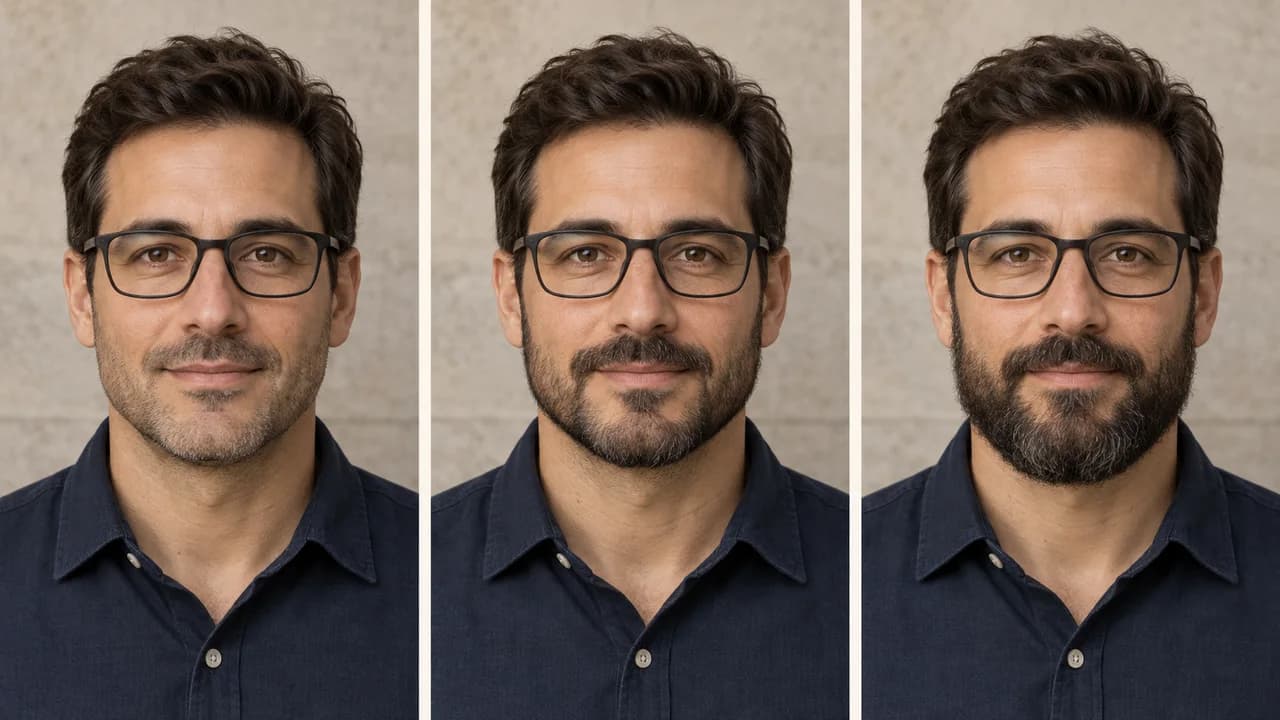
Stubble · leave the jaw visible
A useful starting point when you want the frames and your natural jaw outline to remain easy to compare. Check what coverage you already have rather than expecting the illustration’s density.
Explore stubbleShort boxed beard · a compact outline
Compare the cheek and jaw coverage with your frames without immediately committing to a long chin. Use the guide to understand the shape, then judge it with your own glasses.
Explore the short boxed beardFull beard · more coverage below
Compare the width at the sides as well as the length below the chin. If a longer outline feels too vertical to you, try a shorter option in the comparison before cutting.
Explore the full beard
Change one thing, then check a second angle.
For your own reference photos, keep the glasses, camera distance, lighting and expression as similar as practical when comparing beard options. Take a straight-on view and a gentle three-quarter view so you can judge more than the front outline. This is an editorial comparison method, not a fit measurement.
Keep a reference for the overall appearance you like and say what matters: less width at the sides, less length below the chin, or a visible jaw. A barber can discuss what works with your actual growth; an image is a starting point, not a precise cutting instruction.
BeardStyles can help compare broad beard outlines on a photo. A generated result may alter fine details, including the glasses. It cannot verify frame fit, lens requirements, comfort or an exact future grooming result.
Before you change the beard or the frames.
Do I need new glasses when my beard gets longer?
Not necessarily. Look again with the pair you already wear. A different beard outline may give you the change you wanted without buying another frame.
Are round glasses wrong for a round face?
Face-shape guides often suggest contrast, but that is one styling direction. Try the complete combination and decide whether you enjoy repeating curves or adding angles.
What if the glasses look right but feel uncomfortable?
A style comparison cannot settle comfort or fitting questions. Ask an optician to check the actual frame rather than using a beard photo as proof that the fit is right.
The real guides behind this article.
Sources checked November 1, 2026. These are eyewear-brand styling guides, not a measured popularity ranking or a scientific face-shape formula. The comparison method and images here are original editorial illustrations; source-page traffic is unverified.
- Specsavers UK · beard styles for men with glasses
- Glasses Direct UK · glasses for bearded men
- Framesbuy Australia · glasses and beard styles
- EFE · balancing frames and facial hair
First published
Updated