
Style notes · Hair and beard
Long hair. A beard that fits the whole look.
Compare stubble, a compact short beard and a fuller beard with the way you wear long hair. Choose by outline, actual coverage and everyday upkeep.

In this guideThe whole outline
Long hair does not require a long beard. Start with how you usually wear your hair, then compare a light shadow, a compact beard or a fuller outline. The useful choice is one that works with your actual growth and routine, rather than a universal “best” pairing.
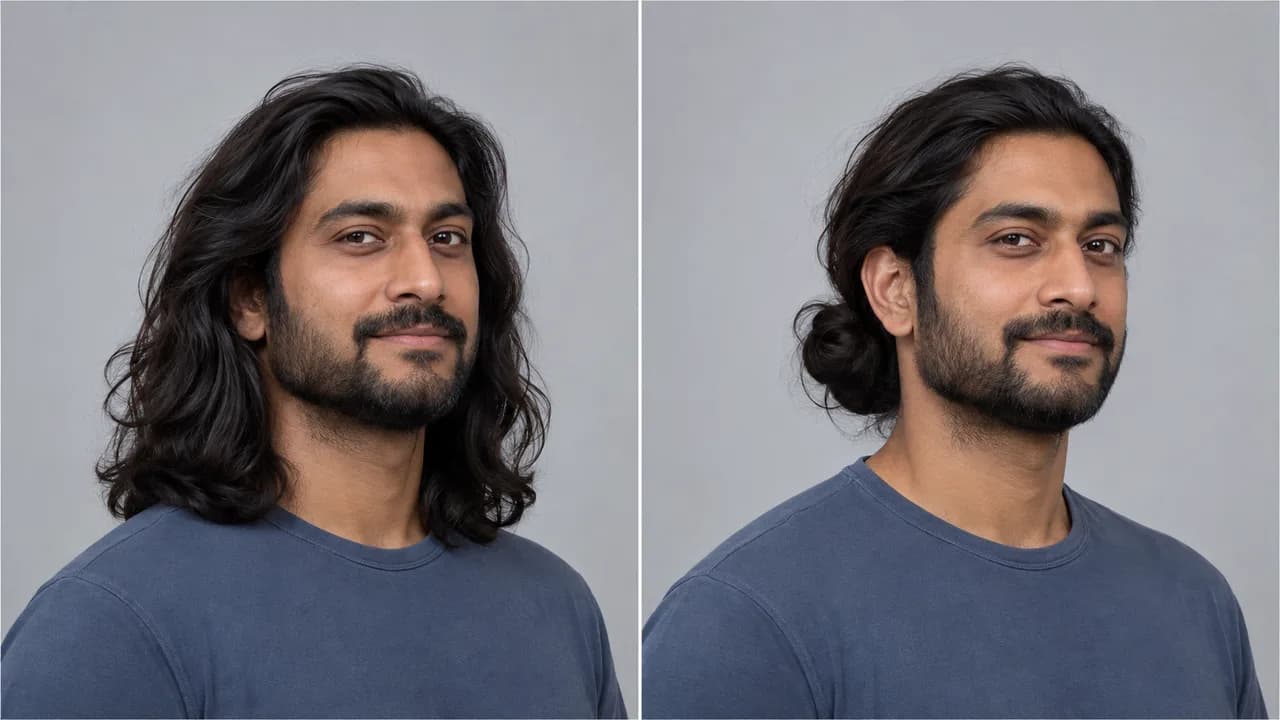
Look at the hair and beard together.
When hair falls beside your cheeks, some of the beard’s outline can be hidden. With the hair gathered back, the cheek, jaw and sideburn connection become easier to see. Judge the beard with the hairstyle you actually wear most days.
Gillette’s long-hair guide includes several beard shapes, while Braun specifically suggests a Balbo pairing. Their different choices are useful reminders that hair length does not dictate one beard. Philips also treats proportion advice as a starting point, rather than a fixed rule.
Compare three amounts of visible beard.
These are three directions to explore, not a ranking. Pick the silhouette you like, then open the matching guide to check its coverage and maintenance requirements.

Stubble · A lighter outline
A visible shadow keeps more skin and jaw contour on show beside loose hair. Beard Beasts includes long flowing hair with heavy stubble among its examples. This can be a useful starting point if you want long hair to be the main feature. Keeping a consistent short shadow still takes upkeep; it is not a maintenance-free option.
Explore stubbleCompact short beard · A defined shape
A short beard can give you a visible lower outline without adding much length below the chin. Compare the width around the jaw as well as the front. “Short” describes a broad category, so choose the amount of coverage you can actually grow and maintain instead of copying a sharp outline that depends on different density.
Compare short beard optionsFuller beard · More presence below the face
A fuller beard is another legitimate direction when your growth supports it. Gillette pairs a full beard with a bun, and Beard Beasts discusses tied-back hair as a way to give a beard more room. Try your usual hair position before removing beard length; wearing both long is a preference, not a mistake by definition.
Read the full-beard guide
Try moving the hair before changing the beard.
If you wear your hair both loose and tied, look at both versions. Keep the beard unchanged and use similar lighting and a normal head position. This separates the effect of moving the hair from the effect of shortening the beard. It is our practical comparison method, not a measurement of attractiveness.
Check three things: whether you like the width beside the cheeks, how much length sits below the chin, and whether you can see the boundary you want to maintain. If length or the neck line needs attention, use the dedicated guides rather than deciding an exact cut from a styling picture.
Choose for the beard you have.
Long hair does not make sparse cheeks fuller. If your cheek coverage does not support the beard in a reference, compare a lighter beard or a chin-focused option such as the Balbo shown in our guide. Check the moustache and sideburn boundaries too; names can describe different shapes in different sources.
Think about the work you want to repeat. Stubble may need regular length touch-ups, while a fuller beard adds more hair to arrange and detangle. A very crisp edge also needs attention. There is no single appointment or trimming interval that makes every combination easy.
A few choices before you commit.
Does long hair always look better with a short beard?
No. Shorter facial hair is one way to create contrast, while a fuller beard can be a deliberate part of the look. Compare both with your usual hair position, rather than treating somebody else’s preference as a rule for your face.
What if I switch between loose hair and a bun?
Choose a beard you like in both everyday positions. Save a front and side reference for each, and decide which outline matters most to you before asking for a change. You do not need a separate beard for each hairstyle.
Can an AI image show which option will work?
A generated image can help discuss a shape, but it cannot prove your density, growth or an achievable cut. Compare our guides against your real beard and use a current photo when talking to a barber. The style finder offers starting points, not a personal assessment.
The guides behind these pairings.
Sources checked on November 4, 2026. The references offer different styling preferences. Our three-direction comparison and hair-position check are editorial guidance, not an individual barber assessment or a promised result.
- Gillette UK · Beard shapes with long hair
- Braun Canada · Long hairstyles and the Balbo
- Philips UK · Proportions and everyday upkeep
- Beard Beasts · Loose and tied-back pairings
First published
Updated