
GROOMING NOTES · TOOLS
Brush or comb? Choose the job first.
Use a comb for tangles and detail, a brush for smoothing. Compare teeth, bristles and a gentle routine before deciding what to trim.
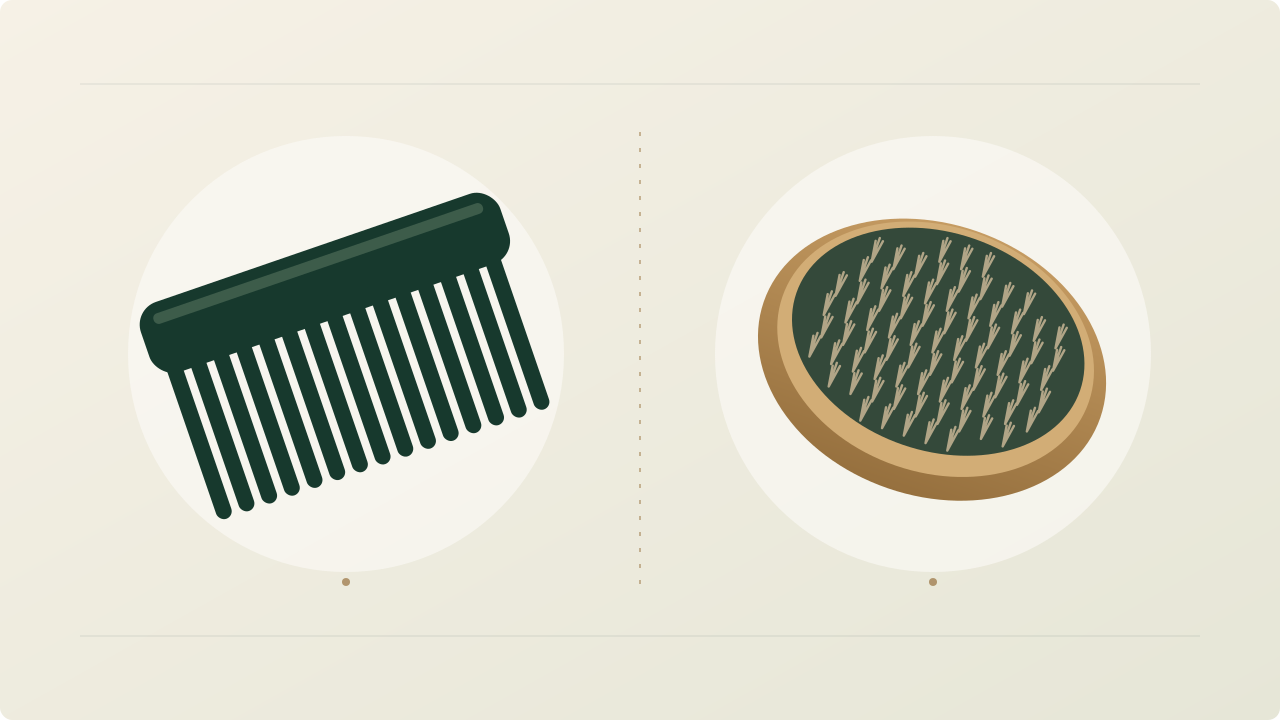
In this guideChoose the task
If your beard catches in knots, reach for a suitable comb. If the hairs are already separated but the surface looks untidy, a gentle brush can help arrange them. Start with that difference rather than buying a complete kit or following a fixed number of months.
What needs sorting: a tangle or the surface?
A comb has a row of teeth that pass between hairs. That makes it useful for working through tangles and arranging small sections. A beard brush has many bristles working across an area, helping bring the visible hairs into a more orderly finish.
The brand guides below often discuss short and long beards, or months of growth. Use those as broad examples. They do not tell you whether a particular tool will pass comfortably through your own texture. Very short stubble may have little to separate, so there is no reason to force teeth through it.
Look at teeth and bristles, not a material ranking.
The useful check is how the tool meets the hair. Inspect the finish and choose spacing or bristle firmness you can use gently. A material name alone does not tell you whether a tool will snag.
Comb · separate and arrange
For hair that tangles, start with teeth spaced widely enough to move through it without a hard pull. Gillette and Beardbrand describe working from the ends, then gradually moving closer to the face. A comb also lets you separate a mustache or check a small part of the outline.
Brush · smooth the visible layer
Use light strokes in the direction you want the hair to lie. Bristles can help spread a product already applied and tidy the surface. If the brush meets resistance, do not press harder: check for a tangle and deal with that first.
Here “comb” means a handheld grooming comb, not a clipper guard or a beard-shaping template.
Detangle if needed. Smooth. Then stop and look.
Gillette advises brushing a dry beard. Let the beard dry for that step, and keep your strokes gentle. More pressure is not a useful substitute for choosing the right spacing or finding the snag.
Work through the part that catches
Start near the ends with a suitable comb and small sections. Move closer to the face as each section passes freely. Pause at a stubborn knot instead of dragging the tool from the skin through it.
Use the brush for the finish
Once the hair is separated, make a few light passes to arrange the surface. Follow the natural lie you want to keep. You do not need to repeat both tools when one already does the job.
Check the outline from more than one angle
Look straight ahead, then check both sides. A neat front view can hide an uneven side. Put the tools down before deciding whether a trim is actually needed.
Judge the beard in its usual position before cutting.
A comb or brush changes how the hairs sit. Lifting everything outward and then trimming every projecting tip can remove hair you meant to keep. For a length comparison, use a dry beard arranged in its usual direction, as our length guide explains.
Choose coverage separately from grooming. A stubble style and a full beard keep different areas, even when both look tidy. Our style guides and photo preview can help compare broad outlines; a generated picture cannot test how a comb or brush feels or tell you exactly where to cut.
Three practical questions before adding another tool.
Do I need both a brush and a comb?
Only if both solve a task for you. A beard that tangles may benefit from combing before a brush finish. If there is nothing to detangle, start with the simpler routine that arranges the hair comfortably.
Can I use a comb I already own?
Check that its teeth are smooth, intact and spaced suitably for the beard. Avoid forcing fine teeth through a section that catches. A familiar comb is not automatically unsuitable, and a premium material is not a guarantee of a good finish.
Can I wash every brush in the same way?
Follow the care instructions for that tool. Remove trapped hairs and product residue, but do not assume a wooden body or every brush construction can be soaked. Beardbrand specifically cautions against running water over wooden brush bodies.
The guides behind this comparison.
Sources checked October 31, 2026. These brands describe their own methods; the task-first sequence here is an editorial adaptation, not a hands-on product test. We have not measured traffic or tested individual brushes and combs.
- Gillette UK · beard brush or beard comb
- Gillette UK · how to brush and comb
- Beardbrand · brush versus comb comparison
- Highgate Cuts · which tool does what
First published
Updated